Showing posts with label education. Show all posts

Monday, March 30, 2009

The crisis in Boston

The eyes of the nation were on Boston in the 1970's. Media coverage of the school segregation crisis was widespread. Cameras and journalists were as common to the students attending school as rioters and protesters. Parents of both the black and white students were extremely outspoken in their efforts to halt or progress the desegregation process.

How do you think the students would have reacted to the busing with out pressure from their parents or the presence of the media? Please answer in the comments section.

Tuesday, March 24, 2009

Education, Race and Civil Rights


The civil rights movement is often examined and talked about as if it was only a Southern issue. Yet, the struggle for racial justice occurred all over the country and was especially explosive in northern cities. The conflict of how to resolve racial segregation in Boston's public schools in the 1960's and 1970's resulted in court-ordered busing and subsequent violence and conflicts.

Over the course of the next few days, we will be looking at 1.) Why Boston's Public Schools racially segregated in the 1960's 2.) Court and community responses to this racial imbalance and 3.) Legacies that this crisis has had on the public school system today.

For homework I would like you to read the following article to gain some background information about Boston and racial demographics during this time period. You do not need to comment, but you will be expected to both review the reading and reflect what you have learned during Wednesday's class. To enlarge the document, please click on the box in the right-hand corner.

Education and Civil Rights Education and Civil Rights msruback

Monday, March 23, 2009

Race and Education

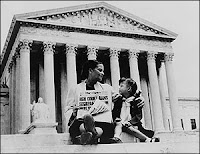
On the eve of the 50th anniversary of the landmark case, "Brown vs. the Board of Education", many scholars, writers, and educators published works examining the legacies of the case as well as reflections about the desegregation and integration process.

For concise background information about the case, please read "Brown v. Board: An American Legacy".

"In the field of public education," the justices wrote, "the doctrine of 'separate but equal' has no place. Separate educational facilities are inherently unequal."

Those words marked the beginning of a long struggle -- a struggle that continues today -- to live up to the promise of equal access to education for all Americans.Then, as now, many people weren't on familiar terms with the names of their Supreme Court justices, but they did know the name of their president. In the days and weeks after May 17, 1954, Americans by the hundreds wrote to tell Dwight D. Eisenhower what they thought about the ruling.

Please click on the link directly above to listen to some of the letters written to President Eisenhower. If you are having trouble listening to the media, please read the transcript found in the bottom of each of the pictures in this photo gallery.

When you are finished, please post ONE thing that strikes you in the comments section.