Showing posts with label HW prompt. Show all posts

Tuesday, May 19, 2009

The Laramie Project: Day 2


Choose TWO of the following. Be sure to read and respond to your classmates' comments.

Many people in the play/movie express a personal guilt over what happened to Matt--and wonder if they could have somehow stopped this crime from happening. Why did these people not step in to stop a crime based on prejudice, discrimination, and hate? What is each person's social and moral responsiblility to stop acts of hate when they see them occur?

The murders Aaron McKinney and Russell Henderson are introduced in this act more fully. What are the different perceptions of these men in the community?

Why do you think the issue of AIDS is brought up in this act? How do we as a society think of AIDS today? Does this stigmatize this crime?

Tuesday, May 12, 2009

More from Jenny Finney Boylan


Jenny Finney Boylan, The author of "She's Not There" wrote an op-ed in this Sunday's New York Times that addresses the question of whether or not she was in a gay marriage in the state of Maine. This was the EXACT question that was brought up in our class: what happens if a transgendered person stays in their marriage? does it become a "gay" marriage? is it legal? does the state recognize it?

Please read the article, Is My Marriage Gay?. I look forward to reading your comments!

Monday, May 4, 2009

When She Graduates as He. . . .

Thank you for your thoughtful comments dealing with gender preferences in children. For tonight's discussion, we are going to shift to talk about gender identity in college students.

For HW, please read "When She Graduates as He", an interesting look at the lives of a handful of Smith and Mount Holoyoke students who decided to transition to the male gender while attending historically all-female colleges. Obviously, this complicates matters on campus.

In your comments, I would like to focus on your thoughts about how this challenges (positively or negatively) the purpose of all women colleges and universities.

If you are interested in this topic, the New York Times also examined this issue. However, the student profiled switched colleges (From Barnard to Columbia).

*In a episode of the Simpsons that aired in 2003, Lisa was visited by a ghost from each of the "Seven Sister" colleges.

Tuesday, March 24, 2009

Education, Race and Civil Rights


The civil rights movement is often examined and talked about as if it was only a Southern issue. Yet, the struggle for racial justice occurred all over the country and was especially explosive in northern cities. The conflict of how to resolve racial segregation in Boston's public schools in the 1960's and 1970's resulted in court-ordered busing and subsequent violence and conflicts.

Over the course of the next few days, we will be looking at 1.) Why Boston's Public Schools racially segregated in the 1960's 2.) Court and community responses to this racial imbalance and 3.) Legacies that this crisis has had on the public school system today.

For homework I would like you to read the following article to gain some background information about Boston and racial demographics during this time period. You do not need to comment, but you will be expected to both review the reading and reflect what you have learned during Wednesday's class. To enlarge the document, please click on the box in the right-hand corner.

Education and Civil Rights Education and Civil Rights msruback

Monday, March 23, 2009

Race and Education

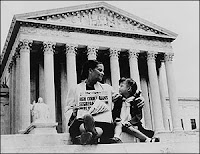
On the eve of the 50th anniversary of the landmark case, "Brown vs. the Board of Education", many scholars, writers, and educators published works examining the legacies of the case as well as reflections about the desegregation and integration process.

For concise background information about the case, please read "Brown v. Board: An American Legacy".

"In the field of public education," the justices wrote, "the doctrine of 'separate but equal' has no place. Separate educational facilities are inherently unequal."

Those words marked the beginning of a long struggle -- a struggle that continues today -- to live up to the promise of equal access to education for all Americans.Then, as now, many people weren't on familiar terms with the names of their Supreme Court justices, but they did know the name of their president. In the days and weeks after May 17, 1954, Americans by the hundreds wrote to tell Dwight D. Eisenhower what they thought about the ruling.

Please click on the link directly above to listen to some of the letters written to President Eisenhower. If you are having trouble listening to the media, please read the transcript found in the bottom of each of the pictures in this photo gallery.

When you are finished, please post ONE thing that strikes you in the comments section.

Thursday, March 19, 2009

Wait a sec! I wanted to say____________________

Is there something that you wish you added to today's conversation? Please reflect, do some research and tell me the one argument/case/connection that you wish you made in the discussion.

This is a mandatory prompt! Everyone should have at least one thing. . .

Thank you!!

Tuesday, February 10, 2009

HW: Tuesday, February 10th


On a separate piece of paper, please answer the following question. This will be collected and graded tomorrow:

Why do you think Delpit tells her daughter that “in many ways now is a more
confusing time to live”? In what sense is it more confusing today? In her view, how does that confusion shape the way the young African Americans she knows view their identity?